Here are some my articles :)
🔗 Critical Analysis: What remains of Edith Finch
🔗 The Interpersonal Boundary and Psychological Distance in Friendship: A Scoping Review
🔗 Orbiting Friendship: Rethinking Personal Boundaries through the Planet App
And here is my AI use statement:
You can also see these articles below. ⬇️
Critical analysis:
What Remains of Edith Finch
There are three levels in the game that increase the difficulty of the player's controllability, namely Molly, Gregory, and Gus. I wanted to explore whether this inconvenient setting helped to express Edith Finch's story, what was its significance, and what effect was achieved in the end? I watched lead designer Lan Dallas' 2018 presentation at GDC, and it was interesting to note that the most important story creation in a narrative game is the last thing in the game's development process. Although it is known that the prototype precedes the creation of the story, since the two need to be "compatible", it means that we can still study the relationship between the two to pursue this degree of fit and effect in our own creative methods.

1、 A brief description of the abnormal mode of operation
(1) Molly
Molly's narrative unfolds through the perspectives of four different species, with the last three—owl, shark, and monster—being characterized by increasingly unconventional controls. While the anomaly coefficient of the operations sees a gradual rise, it sharply decreases in the final segment.
As the owl, player’s mouse is to control the direction and press the left button to dive downward. The difficulty lies in the fact that the controls of the mouse are similar to that of an aircraft. If the mouse moves downward, the owl flies upwards instead (Chart 1); In addition, even if the angle of view is downward, the forward velocity during the dive is still present, which is very different from human motion (Chart 2).

chart 1 The mouse moves in the opposite direction to the picture

chart 2 The actual course of the dive is versus the intended course
Controlling the shark involves using the WASD keys, and it accelerates with the left mouse button. The difficulty is due to the animation of the shark head2, the increased sensitivity of the mouse, and the short time duration of the rush. The control mode of the monster consists of two stages, with only the initial stage involving relatively unconventional operations, afterward movement is governed conventionally using the WASD keys. In the initial stage the camera will not follow the monster's head movement. You need to click the left mouse button to follow the perspective (Chart 3). In the second stage, the monster begins to enter Molly's bedroom, and the camera automatically follows the head.

chart 3 Left mouse button to follow up the view
(2) Gregory
In this segment, the player employs the WASD buttons to navigate the frog doll within the bathtub. Charging is executed by holding the left button, and the doll jumps upon releasing the button. The anomaly in the operation is characterized by the absence of visual cues during these actions until the outcomes are revealed. Players must rely on experimentation, compounded by the scene's cluttered environment and spatial constraints, making navigation challenging.
(3) Dus
The control mechanism involves using WASD to maneuver the kite, directing it to touch all the text appearing in the scene. The anomaly of the operation lies in the inertia of the manipulated kite is significantly enhanced, causing it to move in a trajectory that looks like it is out of control (Chart 4).

chart 4 Schematic of the difficulty of handling the kite
2、 The meaning and effect of abnormal operation
(1) Intentional anomalous operations Through Dallas' presentation at DGC, we can know that they want to and understand how to make the game comfortable. For example, he highlighted the use of Springs which make the movement of the screen more visually natural, and the arbitrariness of subsidiary interactions, such as if the player is close enough to the ladder, no matter what direction they move the stick, the program will regard that you want to use the ladder and make the character move in the right direction. So it's clear that the anomaly we see in the operation is intentional. But this difficulty setting in WRoEF is clearly different from the purpose of other games. Generally speaking, most game difficulties are designed to be overcome, and "players are usually encouraged to accomplish certain things", which is contrary to the emphasis on experience in WRoEF.
(2) Causes of abnormal operation
The reason for this design may be traced back to their own design philosophy. Their emphasis on "create a space to evoke that feeling and kind of encourages them to approach it differently than they would a more traditional game" – a kind of experience design thinking. As far as the experience itself is concerned, the same experience can be obtained in different ways. For example, we are happy about different things, whether it's good weather or you have a great weekend with your friends.
We can also get the emotion of anger just by listening to a story. However, in Gus's game, I believe that most players will not be angry or irritated if they merely listen to the behavior of a rebellious teenager Gus on the day of his father's and stepmother's wedding, becuase they are still just "watching" as a third party. But in the game, because of the abnormal gameplay, the player's inner irritability and slight anger, although whose source is different from that of Gus in the game, the experience is the same. This unique way of resonating with reading—the experience of interaction resonates with the experience of the characters—and thus gives the player a new overall experience (i.e., the experience that is different from the interaction or the story alone, but the experience that the game as a whole brings to the player).
Another example is Molly's story, where the operation is becoming more abnormal, giving players a sense of detachment. In the last part, the way the monster operates will feel very unfamiliar to the player, but there is a shift in the operation of the monster stage, which not only distinguishes between the complete fantasy world and the real world (Molly's room), but also helps the player to further immerse himself. An important part of the weirdness of Molly's ending is that she turns into a monster and eats herself "by herself". The player's operation has changed from an abnormal feeling to an ordinary wasd, and the automatic following perspective can strengthen the "sense of identity" between the player and the monster, reduce the psychological distance between the player and the monster, and thus make the player closer to the situation where Molly and the monster have established the same self.
Some of Gregory's player experience is heavily influenced by the music and visual environment, and thanks to them, this part of the experience is more relaxed and casual. Finally, Gregory dives into the water, and the player's hand is green from the first point of view, a visual effect that retains a "weird" feel. But the prototype itself isn't particularly funny, weird, or motivating. Trying is just the only solution in gameplay. Dallas also mentioned that it wasn't until the background music of the ballet music was added that the feeling of this part became right. And the reason for the anomaly here, he claims to be to give the player a baby's experience - everything is new and interesting, we don't have the constraints of empiricism, we just keep trying to grow.
The experience of the game is the most important concern of the game designer, and the production of WRoEF causes the player to have the same experience as the game character by using prototypes instead of telling the story, which undoubtedly makes the overall game experience more realistic and straightforward. This directness is not the directness of the way of conveying (the designer may have conveyed this thing through various foreshadowing, the rendering of the environment, and the setting of the atmosphere), but the directness of the way of receiving. This also makes WRoEF stand out from the crowd.
(3) Overall effect
The author changed the keyword "sublime" to "overwhelmed" at the beginning of the game, and while it was correct to do so, I think it was precisely because of this conversion of the target word that the sublime did not disappear in WRoEF, instead made the player a part of the sublime. We first need to clarify, "As a performance activity, the game is not complete until the player participates in it, and therefore the player is also part of the content of the game." This makes player’s performances and reactions significant if we consider the sublime of game. These anomalous operating settings, in terms of the overall game effect, make the player not passively experience the sublime, but participate in it.
The sense of sublime always carries with it a mood and state in people's consciousness that is not entirely positive. For example, Bock argues that "fear is always the sublime dominant principle in all situations, whether overt or covert." And Kant said that "and the latter (the sublime emotion) is a pleasure that can only be produced indirectly... Experiencing a momentary blockage of the life force, which is immediately followed by a more intense jet of the life force... It seems to be the seriousness in the activity of the imagination.”
In short, the sense of sublime needs to have a negative premise. Thus, WRoEF’s sublime benefits from those abnormal operation setting. In the game's story, the blockage of characters’ life echoes with the blockage of real operation during the game, and the similar emotional experience more closely unites the player with the game, constituting the premise of the game's sublime sense.

The experience of the sublime is only truly realized when the game concludes, as it necessitates a perspective outside the gaming environment. Because the sublime requires one to look at it out of that environment. Hence, this sublime sensation becomes apparent when the player, now in a more detached state, reflects on the entirety of the gaming experience.
3、 Summary
The intentional inclusion of anomalies in WRoEF undeniably plays a crucial role in elevating the expression of Edith Finch's story. By crafting gameplay experiences that mirror the emotions of the characters, the designers forge a strong connection between the player and the narrative. The emotional experience that the player is invested in the game makes the game feel sublime when the game is finished, when the player's play has become a part of the game. The seamless integration of player emotions with the game's narrative contributes to the high praise garnered by WRoEF, showcasing its distinction in the realm of interactive experiences.
Orbiting Friendship
Rethinking Personal Boundaries through the Planet App
Yanzhi Yang
University of Southern California, yanzhiya@usc.edu
Planet is a gamified social relationship simulation software that re-explores the boundaries of friendship. Users are represented as small planets drifting in the universe, each possessing their own "starfield"—a metaphor for their personal social network. Within this virtual cosmos, users can wander in search of potential online friends, add real-life connections, set their preferred “social comfort distance,” and accept or reject others’ “approach” requests to regulate interaction rhythms. Real-world interpersonal behaviors are translated into a series of metaphorical "physical phenomena," such as gravity, collision, and orbital drift, creating an emotional ecosystem built on order and respect. This paper introduces the project’s design background, core interaction mechanisms, and prototype explorations, and reflects on the potential implications of this design for managing digital social boundaries.
CCS CONCEPTS • Human-centered computing~Interaction design~Interaction design process and methods • Human centered computing~Human computer interaction (HCI)~Empirical studies in HCI
Additional Keywords and Phrases: Interpersonal Boundaries, Ideal Friendship, Speculative Design, Interactive Systems
1 INTRODUCTION
Friendship is often perceived in everyday contexts as a relationship that brings joy and mutual nourishment to its participants, yet many people have experienced the frustration of "unequal" friendships [1]. As a form of intimacy based on voluntary choice, friendship faces similar—but also uniquely challenging—boundary negotiations compared to other forms of close relationships. It involves an inherent contradiction between independence and dependence: too much independence may make the other person feel neglected, while excessive dependence may lead to feelings of suffocation [2]. This project investigates the causes of boundary-related issues in friendships and offers a gamified interactive media experience that allows users to learn and practice gentle, effective boundary negotiation.
2 BACKGROUND
Understanding concepts such as interpersonal boundaries, communication, and privacy provides the cognitive foundation for discussing boundary-setting within the unique context of friendship. This foundation is essential for designing a planetary-style social system. In this section, we outline the key theories, research perspectives, and methodological approaches we adopted, analyze specific real-world issues within friendships, and revisit the marginalized discourses in previous discussions to trace the theoretical support behind the speculative interactive system we propose.
2.1 Interpersonal Boundaries, Communication, and Privacy
Communication Privacy Management (CPM) theory treats personal information as a form of "ownership," where individuals define boundaries to decide with whom, and how much, they wish to share [3,4]. When others violate these boundaries, it may lead to "boundary turbulence." This theory inspired two elements in our design: (1) between users and friends: A mechanism of “social gravity” and “entering another’s orbit.” When others attempt to get closer, the system requires consent. Otherwise, it provides feedback and prompts to protect users’ psychological boundaries. (2) between users and strangers: Users can choose to display or hide their social networks, ensuring that people with different needs for information disclosure can use the system comfortably.
Attachment theory suggests that different attachment styles affect how individuals respond in social interactions. Securely attached individuals are more open to closeness, while those with avoidant or anxious styles tend to maintain distance or feel uneasy when intimacy increases [5]. This provides a psychological basis for designing the "social comfort boundary" feature: different users should be able to define and customize their own interaction boundaries.
2.2 Friendship Maintenance and Social Balance Challenges
Drawing from Relational Dialectics Theory (RDT) [6], we identified three primary tensions in interpersonal relationships: autonomy vs. connection, openness vs. closedness, and stability vs. novelty. These contradictions do not require resolution, but rather dynamic management. It is worth noting that friendship, as a type of intimate relationship, is often idealized in everyday discourse as one characterized by absolute transparency and closeness. As a result, aspects such as autonomy and privacy tend to be overlooked, despite being essential for maintaining relational balance.
The discrepancy between ideal and reality is another key factor affecting satisfaction in friendships [1]. Some individuals may envision ideal friendships as close and affectionate, while the reality might be limited to casual acquaintance or one-sided maintenance. This sense of discrepancy can erode well-being. At the same time, other individuals may desire more personal space in their ideal friendships yet find themselves faced with overly enthusiastic “good friends” in real life. These individuals not only suffer from boundary turbulence but also face misunderstanding or criticism from their friends and from dominant social narratives, which can trigger unnecessary guilt and self-blame.
This phenomenon also reflects how certain tensions in friendship—like the need for independence—tend to be underemphasized within the framework of RDT. These marginalized relational needs often remain unacknowledged, making the experience of emotional discomfort more difficult to articulate or defend.
3 design of planaet
3.1 Design Concept: Planetary Social Distance
We adopted a combined approach of design futuring and metaphor-based interaction design [7], transforming interpersonal distance into tangible representations through "space orbits" and a "gravitational system." Within this spatial metaphor, each user is visualized as a planet, able to define their own social comfort boundaries and sense the attraction or repulsion from others. Inspired by Communication Privacy Management (CPM) theory [3,4], the system includes a "social distance boundary" function: users can designate who is allowed to enter their orbit, like setting privacy zones. If someone approaches without permission, the system simulates a "gravitational conflict" and provides a prompt. Relational Dialectics Theory inspired a dynamic "push-and-pull" mechanism: users can temporarily bring a relationship closer or create distance [6]. This tension is expressed visually through changes like orbit elongation or shifts in planetary glow. Mindful communication theory prompted us to integrate subtle cues such as color fluctuations, light vibrations, or faint sounds, encouraging users to become aware of their emotional responses rather than passively reacting to social rhythms [8].
Healthy friendships often rely on four maintenance behaviors: positivity, supportiveness, openness, and sustained interaction [8]. Intimacy is not static, but an ongoing process of negotiation, adjustment, and redefinition. Our design attempts to externalize these processes through a gamified representation of gravitational forces and orbital visuals, helping users rethink the emotional and philosophical logic behind “social distance.”
3.2 User Interface & Interaction Design
3.2.1User Interface
Each user is visualized as the central star of their own universe. Other users appear as orbiting planets, differentiated by color, brightness, and orbital distance, together forming a tangible "personal social galaxy." The system uses the distance between orbits to represent social closeness: the nearer the orbit, the closer the relationship; the farther the orbit, the more distant or independent the connection. Potential friends provided by the system who have not yet formed a connection are shown as glowing pentagrams without orbits.
Users navigate their personal galaxy using a directional controller located in the bottom-left corner of the screen shown in Figure 1. This circular dial features arrow keys pointing in four directions and only appears when the user attempts to use the joystick, remaining hidden by default to maintain a clean interface.
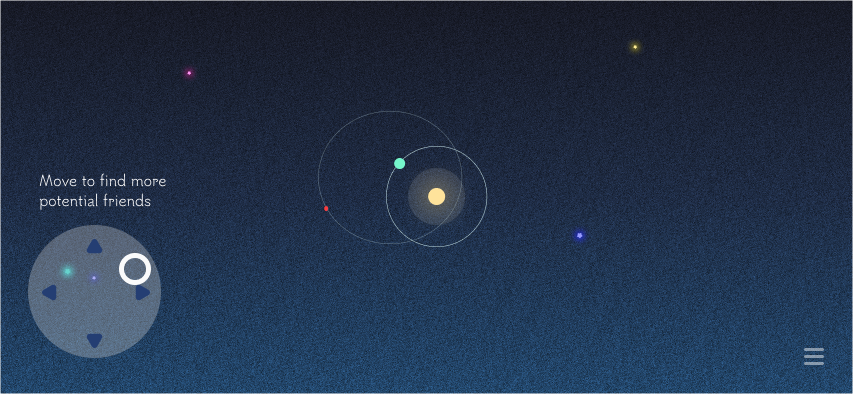
Figure 1: Interface of the movement tutorial with a few friends’ planets in the space
In the bottom-right corner, (see Figure 2) a menu button allows users to manage social settings, such as toggling the “public exploration mode," assigning tags to each contact, or reviewing past interactions. The entire system uses spatial metaphors to help users better understand and manage their interpersonal networks, reinforcing their autonomy over social pacing and boundary control. In terms of visual feedback, the interface reflects relationship dynamics through color, brightness, vibration, and orbital movement. For example, frequently interacting planets tend to stabilize into circular orbits, while fading relationships manifest as elongated orbits, increased transparency, or drifting motion.
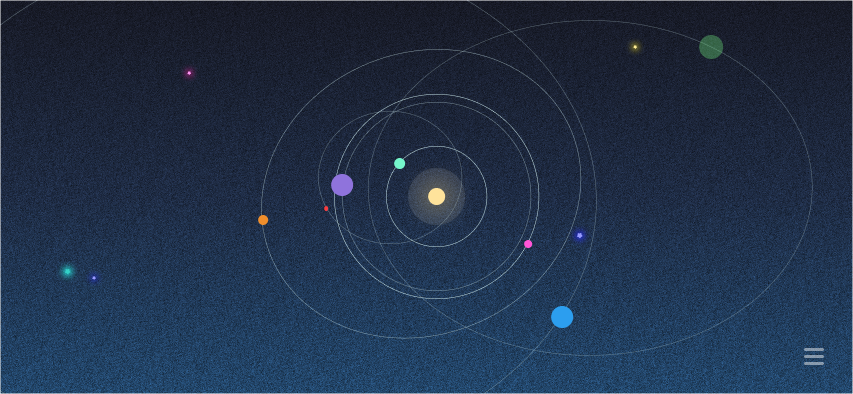
Figure 2: Interface of a normal user with several friends and potential friends in their space
3.2.2Interaction Design
By clicking on a specific planet, users can adjust its orbital radius and shape. It is important to note that all actions that indicate moving toward intimacy, such as establishing a connection or drawing closer, require mutual consent to take effect in the system. However, decisions to move toward independence, such as requesting more distance, are automatically executed by the system without requiring the other party’s approval. That said, these visual changes will only take effect after 30 hours, during which time the initiator can choose to withdraw the request. These interactions are designed not only to change the positions of the planets but also to help users express themselves more courageously, communicate more clearly, and co-create comfortable interaction states for both parties. Whether one wishes to approach or distance themselves from someone, this intuitive, visual interface helps build shared understanding, encouraging communication or mutual, unspoken adjustments driven by respect.
The semi-transparent glow around each planet represents the user’s self-defined social comfort boundary. Upon first launching the application, users complete a questionnaire, and the system generates a default boundary radius based on their answers. A large radius suggests a preference for independence in friendships, while a smaller one implies a desire for closeness. Once inside the program, users can manually adjust their own “social comfort boundary,” similar to establishing privacy rules as described in CPM theory. When someone else nears a user’s comfort boundary, the system triggers a set of visual and haptic feedback cues, such as pulsating glows, subtle orbital trembling, or gentle vibrations, to indicate that the boundary is being approached. For instance, the system may hint: “Perhaps the other person isn’t currently in the state you expect.” If someone applies to reduce their distance but hasn’t received explicit permission, the system simulates a “gravitational conflict,” triggering a repelling animation and a message of rejection.
Another form of interaction between users is the gifting of meteorites. Once two users have entered each other’s stable circular orbits, they can send each other small, customizable meteorites. Each user can view and decorate their own planet by clicking on it. This feature implies that even if a once-close planet eventually disappears from the galaxy, the host’s planet will still retain a meteorite, a trace of that presence, that makes the planet more beautiful for having once been visited.
3.3 Speculative Scenarios
The following are conceptual usage scenarios illustrating how the system functions under various social states. These helps demonstrate the ways in which it represents “dynamic social boundaries”.
3.3.1 Setting Personal Space/ Refusing Contact
A user wishes to remain alone for a period. They set all surrounding planets to the farthest orbit and expand the radius of their social comfort boundary. At this point, any planet attempting to move closer will be automatically pushed back to its original position by the system, accompanied by flashes of a blue halo—symbolizing refusal. If the same user persists in trying to approach, the system will gently display a message: “This user is currently in a low-social state and is not accepting proximity requests.” This mechanism effectively protects the user’s emotional space and helps avoid silent social pressure.
3.3.2 Initiating Connection/ Slow Approach
A user becomes curious about a previously unknown glowing planet recommended by the system. They click to request a connection. After the connection is established, the user gradually adjusts the planet’s orbit to bring it closer to their central star. During this process, the system presents transitional animations such as overlapping halos, gradient color shifts, and smooth rotations, symbolizing the warming of a social bond. If the other person also agrees on their own interface—or takes the initiative to move closer—the two orbital paths synchronize, and the planets begin to “co-orbit”.
3.3.3 Relationship Fading/ Gentle Retreat
A once-close contact is manually moved to an outer orbit by the user, perhaps due to growing distance in real life, or a personal desire for more independence. As the orbital radius increases, the planet’s brightness gradually dims, and the system reduces how often it provides updates about that planet’s status. The user does not need to sever the connection entirely but can express a natural distancing through this gentle adjustment. This design offers a way to withdraw from social interaction without abrupt severance or awkward conversations, allowing for a more graceful transition.
4 DISCUSSION
We meet—perhaps drawn together by each other’s gravity, or maybe by a twist of fate, staying close for a brief moment in cosmic time. We may part ways too—perhaps because one of us begins to accelerate. Sometimes, what we leave behind for one another is matter exchanged; other times, it’s merely the trace of a passing breeze (though there’s no wind in space).
These scenarios are not linear task flows, but rather simulations of social space built upon user autonomy. Through dynamic orbit management, color-based feedback, and semantically expressive animations, the system enables users to “see" the current state of their relationships—or to see the state that the other party cognitively desires or needs. On a behavioral level, such a system may shift how users perceive and engage in social interaction. It forces us to consider: In the invisible gravitational field, who is pulling at our attention? And have we given others enough space to breathe?
When interpersonal relationships unfold like nebulae, every interaction contributes to the construction of a system—a system that is seen as an "Other" relatively independent from the user themselves. Users may begin to sense and acknowledge more sharply and honestly whether their comfort zones are being infringed upon, leading them to proactively adjust their interaction strategies.
These experiences subtly influence how we manage our relationships—not by ignoring others, nor by overreaching, but by seeking a dynamic balance between protecting personal space and maintaining emotional closeness.
Of course, we must remain cautious about the blind spots introduced by technological mediation. Over-reliance on visualized interfaces may distract from authentic emotional exchange. Additionally, differences in users’ interpretations of metaphors could result in misunderstanding or miscommunication.
5 CONCLUSION AND FUTURE WORK
This paper proposes a model for managing social boundaries using a cosmic orbital metaphor, informed by multiple theoretical perspectives including attachment theory, communication privacy management, and relational dialectics.
Looking ahead, we hope to continue refining the Planet system in several ways. For instance, we aim to explore how the initial assessment of a user’s social comfort zone can be made more accurate and universally applicable when they first enter the application. We are also interested in investigating how to design questionnaire items that elicit more truthful and nuanced responses, and how to reconcile the inherently subjective nature of these preferences with the need to quantify them for implementation within a system.
Reference
[1] Melikşah Demir and Haley Orthel. 2011. Friendship, Real–Ideal Discrepancies, and Well-Being: Gender Differences in College Students. The Journal of Psychology 145, 3 (March 2011), 173–193. https://doi.org/10.1080/00223980.2010.548413
[2] John S. Wrench, Narissra M. Punyanunt-Carter, and Katherine S. Thweatt. 2020. Interpersonal Communication: A Mindful Approach to Relationships. Open SUNY, Place of publication not identified.
[3] Sandra Petronio and Wesley T. Durham. 2008. Communication Privacy Management Theory: Significance for Interpersonal Communication. In Engaging Theories in Interpersonal Communication: Multiple Perspectives. SAGE Publications, Inc., 2455 Teller Road, Thousand Oaks California 91320 United States, 309–322. https://doi.org/10.4135/9781483329529.n23
[4] Xiaoxiao Meng. 2024. From Interpersonal Privacy to HumanTechnological Privacy: Communication Privacy Management Theory Revisited. tech. comm. 71, 2 (May 2024), 72–88. https://doi.org/10.55177/tc304825
[5] Luke Norman, Natalia Lawrence, Andrew Iles, Abdelmalek Benattayallah, and Anke Karl. 2015. Attachment-security priming attenuates amygdala activation to social and linguistic threat. Social Cognitive and Affective Neuroscience 10, 6 (June 2015), 832–839. https://doi.org/10.1093/scan/nsu127
[6] Leslie A. Baxter, Kristina M. Scharp, and Lindsey J. Thomas. 2021. Relational Dialectics Theory. J of Family Theo & Revie 13, 1 (March 2021), 7–20. https://doi.org/10.1111/jftr.12405
[7] Abdullah Tarik Celik and Cigdem Kaya. 2025. Reviewing the expansion in design futuring research: Emergent concepts around speculative design and design fiction. Futures 171, (August 2025), 103615. https://doi.org/10.1016/j.futures.2025.103615
[8] Debra L. Oswald, Eddie M. Clark, and Cheryl M. Kelly. 2004. Friendship Maintenance: An Analysis of Individual and Dyad Behaviors. Journal of Social and Clinical Psychology 23, 3 (June 2004), 413–441. https://doi.org/10.1521/jscp.23.3.413.35460
David Krackhardt. Whether Close or Far: Social Distance Effects on Perceived Balance in Friendship Networks. Sarah Cohen, Werner Nutt, and Yehoshua Sagic. 2007. Deciding equivalences among conjunctive aggregate queries. J. ACM 54, 2, Article 5 (April 2007), 50 pages. DOI: https://doi.org/10.1145/1219092.1219093
Eric B. Hekler, Predrag Klasnja, Jon E. Froehlich, and Matthew P. Buman. 2013. Mind the theoretical gap: interpreting, using, and developing behavioral theory in HCI research. In Proceedings of the SIGCHI Conference on Human Factors in Computing Systems, April 27, 2013. ACM, Paris France, 3307–3316. https://doi.org/10.1145/2470654.2466452
Ian Kwok and Annie B. Wescott. 2020. Cyberintimacy: A Scoping Review of Technology-Mediated Romance in the Digital Age. Cyberpsychology, Behavior, and Social Networking 23, 10 (October 2020), 657–666. https://doi.org/10.1089/cyber.2019.0764
The Interpersonal Boundary and Psychological Distance in Friendship:
A Scoping Review
Yanzhi Yang
Abstract
This scoping review explores how interpersonal boundaries and psychological distance present in friendships within digital contexts. As social media reshapes how friendships are formed and maintained, individuals face new challenges balancing intimacy and autonomy. Drawing on Communication Privacy Management Theory, Social Penetration Theory, Relational Dialectics Theory, and Attachment Theory, this paper examines studies from 2005 onward, focusing on self-disclosure, boundary setting, and trust in online and offline friendships. Findings reveal that digital platforms offer both opportunities for connection and risks of boundary blurring. While online friendships can reduce loneliness and enhance self-worth, they may also foster superficial ties and emotional misunderstandings. The review highlights a research gap in studying everyday boundary tensions—such as over-responsiveness or subtle privacy intrusions—and calls for design and educational interventions to support healthier friendship practices in digital environments.
Background
Friendship, as a voluntary interpersonal relationship grounded in intimacy and reciprocity, holds a significant position in the fields of interpersonal communication and social psychology. Traditionally, friendship has often been regarded as a representative form of high-quality relationships (akin to intimate relationships), emphasizing mutual support, emotional exchange, and trust.
Interpersonal boundaries refer to individuals’ regulation or restriction of private information, space, and emotional investment within relationships. These boundaries function to define the extent of interaction between the self and others. Social psychology research suggests that appropriate interpersonal boundaries help individuals define the self, protect emotional security, and foster the development of deeper interpersonal connections. In social interactions, people often need to draw boundaries, both emotionally and in terms of information disclosure, between themselves and others, to preserve self-worth and maintain relational balance.
Psychological distance, in contrast, describes the subjective sense of closeness or detachment one feels toward others and can be understood as a dimension of relational intimacy. Due to varying psychological needs, individuals may have different standards for balancing psychological distance in close relationships.
In today’s rapidly evolving digital context, technologies such as social media and instant messaging have altered how friendships are initiated and maintained. While enabling people to forge new friendships beyond geographical limits, they may also blur traditional boundaries. At the same time, many young people and adults now demonstrate heightened awareness of the dialectical tension between closeness and distance—seeking emotional connection while also protecting independence and privacy. Thus, investigating interpersonal boundaries and psychological distance within the context of the internet not only helps us better understand the evolving nature of modern social relationships but also holds important implications for individual mental well-being.
Method
Literature Search and Screening Approach
This review primarily used Google Scholar, USC Library, and China National Knowledge Infrastructure (CNKI) to collect literature. Keywords included “friendship,” “interpersonal boundaries,” “psychological distance,” “self-disclosure,” and “social media.” The search was limited to studies published between 2005 and the present, to capture research conducted since the rise of internet and social media platforms. Priority was given to studies addressing topics such as boundary-setting, privacy management, self-disclosure, and psychological distance in the context of friendships. Studies that did not address friendship (e.g., those focused only on familial or business relationships) were excluded. That said, for certain foundational theories, references published before 2005 were retained as they contain key concepts still relevant to contemporary discussions.
Core Theories
Communication Privacy Management (CPM)
Proposed by Sandra Petronio, CPM treats private information as personal property. It posits that people believe they own their private information and manage it by setting privacy rules that determine how, when, and to whom to disclose it [3]. CPM emphasizes that when co-owners of information fail to agree on disclosure boundaries, boundary turbulence may occur—disrupting trust and intimacy in a relationship. In friendships, CPM helps explain how individuals decide what aspects of their private life to share with friends, and how they navigate privacy conflicts intensified by social media.
Social Penetration Theory (SPT)
Developed by Altman and Taylor, SPT posits that relational development occurs through increasingly deep and broad self-disclosure. That is, friendships grow stronger as individuals share more and deeper personal information. SPT frames disclosure as a key mechanism for building trust and emotional closeness, which are central to friendship quality.
Relational Dialectics Theory (RDT)
Proposed by Baxter and Montgomery, RDT highlights the inherent tensions within close relationships. It suggests that relationships are defined by ongoing oppositions such as integration–separation and openness–closedness. In friendships, this means individuals often desire deep connection while simultaneously needing autonomy—creating a constant dialectical push and pull. RDT provides a lens for understanding the ongoing negotiation of boundaries in friendships as a process of continuous “repair” and “rebalancing.”
Attachment Theory
Originating in Bowlby’s work, attachment theory explains how early attachment styles shape adult close relationships. In friendships, adult attachment styles—secure, anxious, or avoidant— shape one’s approach to intimacy and distance. Research shows that anxious individuals often crave closeness and worry about insufficient intimacy, while avoidant individuals emphasize independence and may be wary of emotional reliance on others. These behavioral and emotional differences offer a useful theoretical foundation for understanding individual variation in interpersonal boundaries and psychological distance.
Findings
Studies in the social media era have revealed the dual impact of digital platforms on friendships. Some research shows that actively fostering high-quality digital friendships can enhance self-esteem and reduce loneliness. For example, a national survey found that feelings of intimacy and friendship experienced on social platforms were associated with increased self-worth and reduced social isolation over time.
However, the pursuit of large online social circles can also pose problems, especially for today’s youth and even adults. Longitudinal studies show that adolescents who focused on maintaining close friendships—rather than simply expanding their networks—exhibited higher self-esteem and lower anxiety and depression in adulthood. In contrast, young people who relied on broad but shallow networks were more prone to social anxiety. Other research found that for friendships of similar duration, face-to-face friendships involved deeper disclosure and higher levels of trust than online ones. This suggests that while online and offline friendships may follow similar developmental paths, digital interactions often lack the depth of real-world intimacy due to reduced nonverbal cues and physical presence.
One explanation is that social media fosters superficial, fragile “friend-circle” connections that are less capable of supporting deep emotional bonds. While digital tools provide new avenues for maintaining friendships, they also introduce challenges such as blurred privacy boundaries and diluted relational depth. People tend to disclose more to friends they like in order to reduce uncertainty and build trust. Yet in close relationships, both excessive closeness and excessive distance can have negative effects—too much intimacy may lead to conflict, while too much detachment can foster loneliness.
These limitations are in part due to the “physical separation” inherent in online interactions. It is not particularly difficult to form a new friendship online from scratch, but from the perspective of SPT, self-disclosure involves both depth and breadth. Social networks may facilitate higher-frequency, broader communication—but this does not necessarily translate to deeper sharing. This may stem from people’s caution toward the uncertainty of distant, intangible online acquaintances.
Research Gaps and Future Directions
Overall, existing research has identified several key mechanisms underlying friendship boundaries and psychological distance in digital contexts. However, notable gaps and areas for further exploration remain. First, new forms of social media—such as short video platforms, virtual reality, and AI-driven social tools—may impact friendship dynamics in novel ways, but empirical studies on these topics are still scarce.
Second, while much research has addressed how psychological distance in online spaces contributes to loneliness or superficial relationships, there is less focus on boundary violations that arise in subtler, everyday friendship contexts. Most studies on privacy violations concentrate on extreme or harmful cases, which are indeed important to prevent. However, more moderate issues—such as cyber-stalking or demanding excessive responsiveness from a friend—are under- discussed. These are the types of boundary-related problems that many people encounter in everyday life, suggesting substantial value for further research.
As digital life continues to reshape how we handle intimacy, new challenges inevitably arise—especially for adolescents, whose cognitive and emotional regulation skills are still developing. If young users could be supported through education or be offered gentler, more respectful systems for expression within social media environments, it could make a significant positive difference.
In the field of design, there is still much unexplored territory. Based on the foundation of existing studies, designers and scholars alike have important opportunities to jointly investigate and create new frameworks and systems to support healthier, more balanced friendship experiences in the digital age.
reference
Baxter, L. A., Scharp, K. M., & Thomas, L. J. (2021). Relational Dialectics Theory. Journal of Family Theory & Review, 13(1), 7–20. https://doi.org/10.1111/jftr.12405
Demir, M., & Orthel, H. (2011). Friendship, Real–Ideal Discrepancies, and Well-Being: Gender Differences in College Students. The Journal of Psychology, 145(3), 173–193. https://doi.org/10.1080/00223980.2010.548413
Ito, M., Odgers, C., & Schueller, S. (2020). Social media and youth wellbeing: What we know and where we could go. https://clalliance.org/wp-content/uploads/2020/06/Social-Media-and-Youth-Wellbeing-Report.pdf
Krackhardt, D. (n.d.). (2007). Whether Close or Far: Social Distance Effects on Perceived Balance in Friendship Networks. https://doi.org/10.1145/1219092.1219093
Meng, X. (2024). From Interpersonal Privacy to Human Technological Privacy: Communication Privacy Management Theory Revisited. Technical Communication, 71(2), 72–88. https://doi.org/10.55177/tc304825
Norman, L., Lawrence, N., Iles, A., Benattayallah, A., & Karl, A. (2015). Attachment-security priming attenuates amygdala activation to social and linguistic threat. Social Cognitive and Affective Neuroscience, 10(6), 832–839. https://doi.org/10.1093/scan/nsu127
Oswald, D. L., Clark, E. M., & Kelly, C. M. (2004). Friendship Maintenance: An Analysis of Individual and Dyad Behaviors. Journal of Social and Clinical Psychology, 23(3), 413–441. https://doi.org/10.1521/jscp.23.3.413.35460
Pennington, N. (2021). Extending Social Penetration Theory to Facebook. The Journal of Social Media in Society. 10(2).325-343. https://www.thejsms.org/index.php/JSMS/article/view/973/549
Petronio, S., & Durham, W. T. (2008). Communication Privacy Management Theory: Significance for Interpersonal Communication. In L. Baxter & D. Braithwaite, Engaging Theories in Interpersonal Communication: Multiple Perspectives (pp. 309–322). SAGE Publications, Inc. https://doi.org/10.4135/9781483329529.n23
Sheldon, P. (2010). Similarities and differences in self-disclosure and friendship development between fact-to-face communication and Facebook [Doctor of Philosophy, Louisiana State University and Agricultural and Mechanical College]. https://doi.org/10.31390/gradschool_dissertations.3563
Tyack, A., & Mekler, E. D. (2024). Self-Determination Theory and HCI Games Research: Unfulfilled Promises and Unquestioned Paradigms. ACM Transactions on Computer-Human Interaction, 31(3), 1–74. https://doi.org/10.1145/3673230
Wisniewski, P. (2011). Interpersonal boundary regulation within Online Social Networks. 2011 International Conference on Collaboration Technologies and Systems (CTS), 630–632. https://doi.org/10.1109/CTS.2011.5928748
Wrench, J. S., Punyanunt-Carter, N. M., & Thweatt, K. S. (with Open Textbook Library). (2020). Interpersonal Communication: A Mindful Approach to Relationships. Open SUNY.
Zheng, L. R., Oberle, C. M., Hawkes-Robinson, W. A., & Daniau, S. (2021). Serious Games as a Complementary Tool for Social Skill Development in Young People: A Systematic Review of the Literature. Simulation & Gaming, 52(6), 686–714. https://doi.org/10.1177/10468781211031283